Been a while since I’ve done a restaurant review. Since having the young’in we don’t get out as much, and when we do, we’re usually looking for a sure thing rather than take a chance. Last night was a special occasion, and we decided to try out RN74, a relatively new downtown place that had gotten multiple favorable reports from friends.
We were there relatively early, on a Saturday night. The bar was already pretty full, though the dining area was empty. The space is pretty cavernous and as it continued to fill, the noise levels increased accordingly. The atmosphere is semi-train station inspired including an old style rotating board listing the most recent wine purchases. That sign is a feature that they are proud of, but it is mostly annoying. It is loud and they like to feature very expensive bottles that have been purchased. Sort of the equivalent of being allowed to drive your Maserati to your table, too ostentatious for my taste. Similarly, the seating is arranged to make sure the diners can see and be seen. Sitting at a table in the center of the room, I felt much too much on display. It was not comfortable.
The servers and wait staff were excellent: friendly, helpful, and courteous.
The menu is small, not tiny, but you may want to make sure there are options for everyone in your party. I had a couple tough decisions to make since there were multiple things I wanted, but my wife ended up ordering multiple appetizers and sides to make her meal.
I ordered their take on an Old Fashioned for my pre-dinner libation. Not my usual cocktail. This was easily the best version I’ve had. I would definitely order that again.
For desert, my wife opted for the Petit Fours, while I got the Sticky Toffee Pudding. The Petit Fours were horrible. Really bad. We sent them back completely uneaten. The Sticky Toffee Pudding was middling at best, mediocre.
To the wait staff and restaurant’s credit, they didn’t charge us for the things we did not eat, but even so, this was a fairly pricey meal.
All-in-all, RN74 was an uneven experience. The highs were high and the lows were low, but the highs were not transcendent enough to justify their price tag or outweigh the lows. Will we return? Unlikely. Maybe for a drink in the bar. There are enough good options in the neighborhood in and below the price range of RN74 with better atmosphere. So, we will probably not get around to returning.
If you want to check it out yourself: get a booth, not a table; stay off the sides of the menu; and have desert somewhere else.
Amongst my many problems is the fact that I am a bit of a pack rat. Not bad enough to be on “hoarders” but bad enough that I have a hard time getting rid of stuff. My studio at home is cluttered with hundreds of books, CDs, DVDs, video tapes, papers and other assorted items I’ve accumulated over my life. Books are the toughest for me to part with. I’m always picking them up faster than I can finish them so the piles get larger and larger. Also books are the biggest shelf hogs off all the stuff I accumulate. Part of the problem is that even once I finish a book, I always assume that I’ll want it around to re-read or reference some day.
The answer is, of course, to stop buying new books until I make up some lost ground in my to read pile and just get over my fetishizing of
the books I’ve already read. Like any pack rat will tell you, that is pretty tough to do.
A more modern answer is to switch to buying e-books. This won’t fix my deepening pile of To-Read things (in fact it might make it worse because I won’t be able to see my physical pile of books to read), but it would address the clutter.
I love the concept of e-books. There are a lot of books that I buy that I won’t buy as e-books, like art monographs, but mostly I read non-fiction. For the majority of the books I read, the physical object really isn’t doing anything special for conveying the ideas. Most of the stuff I read would come across just fine on an electronic reader. To this end, I did get one a couple years ago. However, when I started to look into buying e-books, I was pretty disappointed.
I have a rule about DRM. I won’t buy any digital item with DRM. I’ve been burned several times over the years with vendors sunsetting their DRM schemes leaving their customers with a lot of bits they paid for but cannot access. DRM-free versions of e-books absolutely exist, but with such a high premium that they are often much more expensive than their physical counterparts. Even the DRM’d e-books are often as or more expensive than their physical versions, especially if they have already been out for a few years. So with the exception of a few O’Reilly titles, I basically haven’t purchased any e-books and have mostly just used my e-reader to read academic papers or other PDFs.
Last year, I purchased a Fujitsu ScanSnap scanner to help me address the piles of papers cluttering my desk, file cabinet and boxes in the garage. This was the answer to my pack-rat ways. It allowed me to have digital, searchable, copies of every piece of paper I ever wanted without having to actually keep the physical piece of paper. As I said, it also meant that I have a searchable archive, thanks to DRM. I’ve slowly been working my way through all my clutter, one file folder and one box at a time and it feels liberating. I’m finally clearing out magazines I’ve saved for 10 years to read one article and ridiculous crap like that. My recycle bin is always full.
Today, I finished reading Daniel Pink’s Drive. I read most of it a while ago, but it was sitting on my nightstand for a year or so while I read other books until I got around finishing it. I won’t review it here, other than to say that it was a pretty good book, but if you watch this video and understand the concept, you really have no need to buy it. This was a book that I thought was pretty good, but it didn’t say anything to me that I didn’t already know. What I should have immediately done was put it in a box to donate to a library, or given it to a friend, or a clueless boss, or something. Instead, I went to find a place for it on one of my overwhelmed shelves.
Then I spied my scanner.
I realized that this physical book didn’t have anything special about it. It came from a computer file, was printed on cheap paper and was actually the worst manifestation of the ideas from a standpoint of me being able to reference it again. If there was something I remembered from this book that I wanted to look up: I’d need to remember that it came from this book instead of from another one, then I’d need to remember where I put the book (home, work, a box in the garage), and then I’d need to actually find the section of the book that I was looking for. These days, I probably wouldn’t get past step one. I’d google for my answer and then never go to step two.
I decided to see how hard it would be to turn my physical book into an e-book for future reference. It was actually really easy. The whole process took less than twenty minutes.
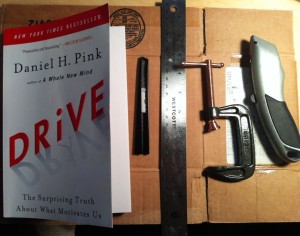
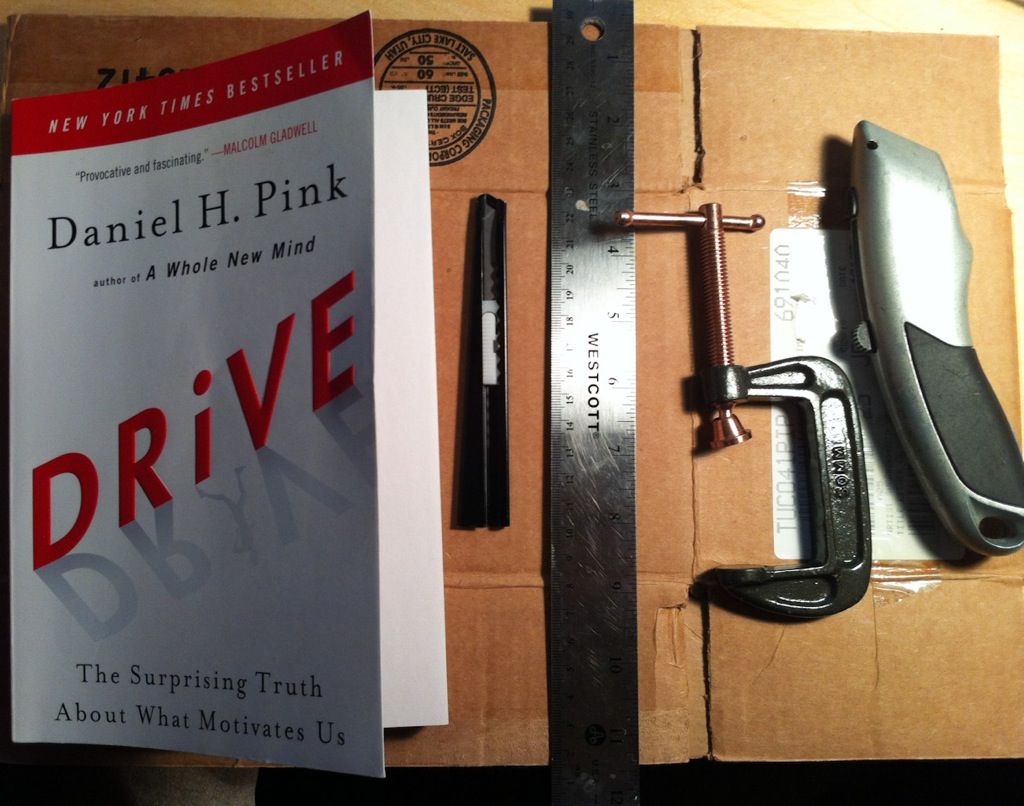
First I got the tools… Tools of (Creative) DestructionI ended up not needing the smaller box cutter, the bigger one worked great.
Here we goI clamped the book to my desk. It is upside down because I’m right handed and I didn’t want to slice my fingers off. The ruler was only necessary for the first couple passes, but I kept using it as a finger guard. I put the ruler a bit in from the spine of the book and just got to work.
faster progress than I expectedI figured that it was going to take a really long time to slice through a whole book with an admittedly dull box cutter, but actually it took nearly no time at all.
almost doneThis was maybe 8 times through with the box cutter in a 260-some page book.
<Ready for scanningBefore I did this, I figured this was going to take me for ever. It probably took me more time to get all the tools together than it did for me to finish slicing off the spine.
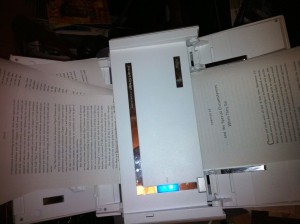
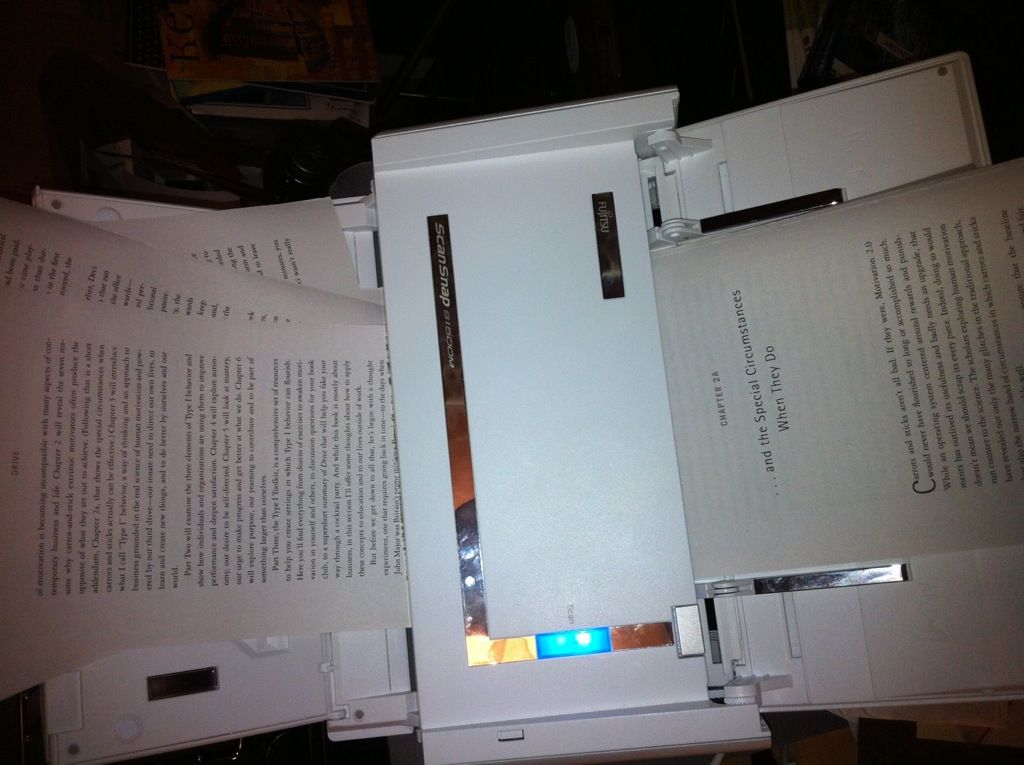
The scansnap does its jobI just started feeding pages into the scanner. That went quick.
scanning...Man, I love the ScanSnap.
into the recycling binIt felt a bit weird, throwing a book into the recycling bin. I had a bit of a hard time with that. Part of me was ready to find a jumbo binder clip so I could still keep the book. That is really how my mind works.
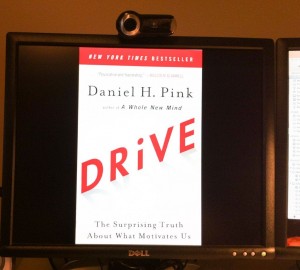
in AcrobatI used Acrobat Pro’s OCR engine on the PDF generated by the ScanSnap. The original PDF was 26MB. After OCR, it was less than 11MB and more legible. The OCR went pretty quick. I guess this is about the best possible case for an OCR engine, so that shouldn’t be too surprising.
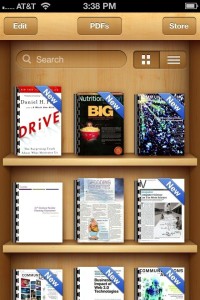
Live in iBooksAnd here is my new e-book on my virtual bookshelf.
reading in iBooksAnd here it is in the iBooks reader app.
The nice thing is that I could also read it on pretty much any e-reader, computer, or mobile device with a screen. That is the genius of open standards and DRM-free files. Even if some day the PDF format dies, I know that I’ll be able to take my book to whatever the next format or reading device is. Just like a real book.
I’m privileged to once again be speaking at the SC conference. For those who don’t know it; “SC is the International Conference for High Performance Computing, Networking, Storage and Analysis.” If you are attending, I’ll be on a panel entitled Parallelism, the Cloud, and the Tools of the Future for the next generation of practitioners. I’ll be joining some of my compatriots in the Educational Alliance for a Parallel Future to once again discuss the skill sets that collegiate computer science programs should (and mostly aren’t) imparting to their students in the areas of parallel programming.
The abstract for the panel is as follows:
Industry, academia and research communities face increasing workforce preparedness challenges in parallel (and distributed) computing, due to the onslaught of multi-/many-core and cloud computing platforms. What initiatives have begun to address those challenges? What changes to hardware platforms, languages and tools will be necessary? How will we train the next generation of engineers for ubiquitous parallel and distributed computing? Following on from the successful model used at SC10, the session will be highly interactive, combining aspects of BOF, workshop, and Panel discussions. An initial panel will lay out some of the core issues in this topic with experts from multiple areas in education and industry. Following this will be moderated breakouts, much like collective mini-BOFS, for further discussion and to gather ideas from participants about industry and research needs.
If this sounds similar to the session from the Intel Developer Forum in September, there is good reason. It was the second most popular session of that conference. The IDF panel and breakout sessions covered some really interesting ground, and I really liked the format. I felt like the discussions I had with the people in my subgroup at IDF were deeper, more specific and more productive than a traditional panel format would have been.
While the speakers in this panel are different than the one in September, I think we’ll still end up splitting on the axis of using abstractions to teach fundamentals vs teaching from the first principles up. Which camp you are in seems at least somewhat determined by the fact that a number of panelists produce abstractions over the low-level elements as part of their work. I am very much in the fundamentals camp as I think that understanding what the abstractions are built on is fundamental to choosing the right abstraction, much as artists tend to start with representative figure drawing. What will make an interesting difference from IDF is the number of audience members who come from outside of computer science (HPC is used more by scientists for whom the computation is only a means to the end of solving a problem in a non-computational discipline). Those audience members are less likely to understand the fundamentals, nor care. For them parallelism is just a tool to get their answer faster. This should really make for a lively debate!
My statement for the panel is as follows (yes, I did crib the last paragraph from my earlier position):
The team I manage is building a single, modern, software product. A few years ago, that would have meant a desktop application written primarily in C++, most likely single-threaded. Today, it means software that runs on the desktop, but also on mobile devices and in the cloud. Working in my organization are developers who write shaders for the GPU, developers who write SSE (both x86 and ARM), developers using distributed computing techniques on EC2 and threads everywhere throughout the clients and server code. We write code in C, C++, ObjC, assembly, Lua, Java, C#, Perl, Python, Ruby and GLSL. We leverage Grand Central Dispatch, pThreads, TBB and boost threads. How many of the technologies that we use today in professional software development existed when we went to school? Nearly none. How many will still be used in a few years from now? Who knows. The reason we can continue to work in the field is that our education was grounded not just in programming techniques for the technology of the time, but also in computer architecture, operating systems, and programming languages (high level, low level and domain-specific).
Learning GPGPU was much easier for me because I could understand the architecture of graphics processors. I was able to understand Java’s garbage collection because I understood how memory management worked in C. I chose TBB over Grand Central Dispatch to solve a specific threading problem because I could evaluate both technologies given my experience
with pThreads.
We’re doing students a disservice if we teach them the concepts using high-level abstractions or only teach them a single programming language. Having an understanding of computer architecture is also critical to a computer science education.
These fundamentals of computer science do not necessarily need to be broken out into their own classes. They can and should be integrated throughout the curriculum. Threading should be part of every course. It is a critical part of modern software development. Different courses should use different programming languages to give students exposure to different programming models.
If I was a Dean of Computer Science somewhere, I¹d look to creating a curriculum where parallel programming using higher-level abstractions was part of the introductory courses using something like C++11, OpenMP or TBB. Mid-level requirements would include some computer architecture instruction. Specifically, how computer architecture maps to the software that runs on top of it. This may also include some lower level instruction in things like pThreads, Race conditions, lock-free programming or even GPU or heterogenous programming techniques using OpenCL. In later courses focused more on software engineering, specific areas like graphics, or
larger projects: I¹d encourage the students to use whichever tools they found most appropriate to the tasks at hand. This might even include very high level proprietary abstractions like DirectCompute or C++AMP as long as the students could make the tradeoffs intelligently because of their understanding of the area from previous courses.
You can read the position statements from the rest of the panel here.
Getting this into your hands required a tremendous effort from a great team, and there is a lot more to come. More than just supporting more platforms like Android and Windows. This first version is just the tip of the iceberg. We wanted to put it into your hands, but it isn’t done. There is a lot more we want to do, but we want to hear from you. What do you need to make Adobe Carousel work even better for you? We want to know. We’re already hard at work on the next release, and hope to put it into your hands soon. Until then, download the client from the Mac App Store (requires Lion) or the iTunes app store. We have a 30 day free trial. Upload some photos, create a new Carousel to share with family or friends. Edit your photos and see how much Adobe imaging power we’ve been able to fit in your hands. The subscription pays for UNLIMITED storage for both you AND THE PEOPLE YOU SHARE WITH. That is a pretty serious deal.
Want to know more? This post on the Photoshop blog provides a lot of the official details and links.
This video summarizes what we are trying to create:
and this video tells you more about the team that I am so proud to be a part of (no actors, just really us):
Wondering why I sound so tired in that video? We shot it only days before we finished the product and we’d all been putting in long hours for weeks!
I’m posting this here because it took me more than 20 minutes of googling to find the answer (and I’m an Adobe employee).
The Adobe Connect uses Flash and sometimes if you do an update to Flash on your system, Connect gets into a bad state. The way you’ll see this is that when the Add-in tries to launch it will get stuck with a small window that says “Loading Adobe Connect…” that never finishes.
The way to fix this problem is to uninstall Adobe Connect. Unfortunately, Adobe doesn’t make it easy for you to do that. there is no uninstaller and no information on the Adobe web site. Here is where the add-in is installed
Delete that directory and you have now uninstalled the add-in. Your connect sessions will now be hosted in your web browser until the next time you need add-in functionality, at which time you’ll be prompted to re-install it.
Hopefully this solves your problem and you found it faster than I did.
As a hiring manager building teams working on modern computer software; I’ve often been disappointed in the lack of a proper foundation in parallel algorithms and architectures being taught in current Computer Science curricula. To that end, I’ve been working with a group called the Educational Alliance for a Parallel Future that aims to improve Computer Science curricula in this critical area. The EAPF is once again convening a panel of educators and industry representatives to talk about this important issue and once again I am delighted to participate.
The panel is entitled: Parallel Education Status Check – Which Programming Approaches Make the Cut for Parallelism in Undergraduate Education? Unlike previous iterations of this panel where we spoke in generalities, this time we’ll be diving a bit deeper into specific technologies that we think are good starting places for educators to introduce to their students.
Here is an excerpt of the abstract: The industry and research communities face increasing workforce preparedness challenges in parallel (and distributed) computing, due to today’s ubiquitous multi-/many-core and cloud computing. Underlying the excitement over technical details of the newest platforms is one of the thorniest questions facing educators and practitioners — What languages, libraries, or programming models are best suited to make use of current and future innovations? This panel will confront this conundrum directly through discussions with technical managers and academics from different perspectives. The session is convened by the Educational Alliance for a Parallel Future (EAPF), an organization with wide-ranging industry/academia/research membership, including Intel, ACM, AMD, and other prominent technology corporations.
The panel will be presented on September 15th, 2011 at 10:15am as part of the Intel Developer Forum 2011 at the Moscone Center in San Francisco, California. There are free passes for interested educators. Register now for a free IDF day pass using promo code DCPACN1.
My specific take has always been that I am not as interested in grounding in a specific parallelism library or abstraction. The pace of change in this area has only increased over the last few years with the rise of multi-core, GPGPU, HPC and heterogenous computing. Techniques and libraries have arisen, gained adoption, and fallen out of favor one after another.
A developer who only understands how algorithms can be mapped to OpenMP-style libraries is not as useful once the team moves to Grand Central Dispatch or OpenCL. A grounding in traditional task-level parallelism as well as data-parallelism techniques is a starting point. It is important not only to understand what each of them are but the different types of problems that they are each applicable to.
Higher level abstractions like OpenMP are good for introductory courses. However, it is important to understand fully how high-level abstractions map to lower level implementations and even the hardware itself. Understanding the hardware your software runs on is critical to find the best performance for your code. It is also critical to understanding why one particular higher level library might work better than another for a particular task on specific hardware.
Once you understand things like hyperthreading, pThreads, locking mechanisms, and why OpenCL or CUDA maps really well to specific problems, but not to others, then you can return to using higher level abstractions that let you focus on your algorithm and not the details.
If I was a Dean of Computer Science somewhere, I’d look to creating a curriculum where parallel programming using higher-level abstractions was part of the introductory courses using something like C++11, OpenMP or TBB. Mid-level requirements would include some computer architecture instruction. Specifically, how computer architecture maps to the software that runs on top of it. This may also include some lower level instruction in things like pThreads, Race conditions, lock-free programming or even GPU or heterogenous programming techniques using OpenCL. In later courses focused more on software engineering, specific areas like graphics, or larger projects: I’d encourage the students to use whichever tools they found most appropriate to the tasks at hand. This might even include very high level proprietary abstractions like DirectCompute or C++AMP as long as the students could make the tradeoffs intelligently because of their understanding of the area from previous courses.
Given that the panel consists of representatives from Intel, AMD, Microsoft, Georgia Tech as well as myself, I’m expecting this to be a very spirited conversation. I hope to see you there.
I just approved and then changed my mind and un-approved a comment. The comment was a fair, if somewhat harsh, criticism of the Pixel Bender Toolkit. I originally decided to approve it because it was one person’s opinion and a response to something I wrote, and I don’t mind answering criticisms (even when they are worded less-than-delicately). However, I changed my mind because the writer decided not to include a valid name or e-mail to respond to.
So, that will be a rule I’m going to hold on to moving forward. If you want to post your honest opinion to something I write, I will always try to honor you and will post it; and respond. As long as your comments are:
honest
not advertising
not overt flame-bait
do not swear
are signed with your real name (or handle) AND e-mail address (which is not published, but lets me know that you are willing to put your name to something)
Hopefully, this should not strike anyone as draconian.
JJ, if you want to re-post with your real name and e-mail address, I will gladly approve your comment.
Tomorrow morning, I’ll be speaking with Paul Steinberg of Intel and Tom Murphy of Contra Costa college about the criticality of understanding parallel programming techniques for industry.
In my previous role on the Adobe Image Foundation, it was an obvious requirement for our hiring candidates. We were building tools for a insanely parallel problem, image and video processing. Now that I’m working on a new product, it would maybe seem that it would not be as important. In fact, our threading models are even more complicated than in my previous group. My expectations around threading knowledge for incoming candidates are just as high.
Even the most modest mobile hardware is going (or has gone) parallel. In addition, the expectations from a user perspective around interactivity with their applications is never higher. A laggy touch interface is death to an application (or a platform). Going to get coffee while your image renders on a desktop is a thing of the past. User’s expectations of the software we write is higher than ever and it is nearly impossible to get this interactivity without taking advantage of multi-threading on today’s multi-core processors.
The tools continue to improve, but the threading models continue to evolve. A fundamental understanding of multi-threading is critical for anyone moving into Software Engineering or looking to stay current in their field.
I always enjoy talking with Paul and Tom, and expect that we’ll have a lively conversation.
If you are planning on attending the AMD Fusion Developer Summit in Bellevue, WA in June, come see me talk about Pixel Bender (probably for the last time!) with Bob Archer. Here is the description of the session:
Pixel Bender is a domain-specific image processing language created by the Adobe Image Foundation, and includes a runtime designed to work well across heterogeneous hardware, scaling efficiently for multiple cores. This runtime currently ships in a number of Adobe’s flagship products. Bob Archer, Technical Lead, and Kevin Goldsmith, Engineering Manager, will talk about the design of the language, compilers, and runtime. They will also discuss how the Adobe system can incorporate complimentary technologies like OpenCL and can scale to accommodate new hardware paradigms like the AMD Fusion processors.