
this is funny. I can’t believe that he was able to make it look this good this quickly.
Category: Technology
Live from Macworld 2007: Steve Jobs keynote – Engadget
Live from Macworld 2007: Steve Jobs keynote – Engadget
Engadget always has my favorite Apple keynote coverage.
So, Apple TV has a hard drive. Ok, cool. $299, decent
So the iPhone is official! widescreen, touchscreen, 4 or 8GB of RAM, runs OS X, lives on Cingular. Do I want one? Absolutely. At $499 will I buy one? extremely doubtful
Where is the new iPod and new iLife? Where is the One more thing? Don’t hold out on us now!
Oh, so much to love about January
CES, Mac Expo and NAMM. A tech and gear geek’s favorite month of the year!
Guess what? I’m not going to any of them (got some big deadlines coming up), but I am following all the action, ya know, remotely.
So here’s what I’ve found so far:
- MacWorld: The expectations game – MacWorld talks about how the expectations for Steve Jobs’ keynote have gotten so high that they is no way it won’t be a major disappointment. Which is possibly a problem for Apple stockholders.
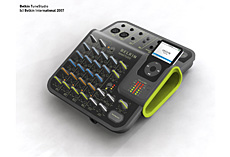
- Belkin introduces and iPod based recording studio – Well, the iPod is a hard drive, so why not build a 4-track mixer with hard disk recorder around it. Kind of unnecesary, but cool. They don’t say if it is battery powered, in fact they only mention USB power (which is REALLY unnecesary).
- Intel unveils new quad-core processors at CES
- Toast 8 – new version has TivoToGo, BluRay recording and (finally!) spanning burns across multiple discs and cataloging.
- Ultra-Mobile PCs from Oqo and Sony. and a prototype from Fujitsu
- JVC HD Everio – Full HD at a prosumer price. Less than 2K for 1920x1080i recording to a 60 GB harddrive!
Why we won’t see an Apple Tablet next week
What Jobs told me on the iPhone | Technology | Guardian Unlimited Technology
David Sobotta writes a blog that is about as close to mini-MSFT for apple that I’ve seen. He doesn’t dish the dirt the way that Mini does, but he does shed light into the murky corridors of power on the infinite loop. Of course, I know from my Apple buddies that it is crazier there than you could possibly know, especially around secrecy. I think that secrecy is probably the reason why we don’t see a mini-APPL. No one who works there has any idea about what is going on…
Google Apps
Computing | Work-life balance | Economist.com
interesting article on companies adopting Google apps for their needs. One quote did stand out however:
“I have a staff of about 30 people dedicated to security,†says Mr Sannier. “Google has an army; all of their business fails if they are unable to preserve security and privacy.†Google’s Mr Girouard says a similar evolution in trust occurred when people reluctantly accepted that their money was safer in a bank than under a mattress.
There is a fundamental thing wrong with this argument. As Google aggregates more and more user data, it become more of a target for hackers. And as we’ve already seen, Google may have an army, but they aren’t perfect.
Part of the reason that people started to trust banks was that the FDIC insured their accounts. If your bank was robbed or it went under, you’d still have your money. If someone steals your identity (or any digital part thereof), Google can’t (and won’t) help you.
Springwise: best of 2006
Springwise: new business ideas for entrepreneurial minds.
This is a great site, always worth a visit. They just did all their tops of 2006 lists. I went through all of them so that you don’t have to:
- Covering up IKEA: a company that sells high-quality slip covers for Ikea furniture.
- Garden offices for lawn commuters: pre-fab, high quality, garden sheds for the digerati.
- Real estate 3.0: selling houses that aren’t for sale: a website that lets you bid on houses that aren’t for sale yet
- Everyone’s publisher: Blurb lets aspiring authors publish books themselves easily.
- JPG 2.0 | Customer-made magazine relaunched
- Angelic crowdsourcing: raising money from the net to make an open source movie (similar idea to what I wrote about in Television and the Long Tail and Stray Cinema)
- Channeling online video: an article about a travel site that uses short videos of locations to help get people interested
- Mass made to order, here: a company that uses 3D CAD software and a computer controller cutting machine to create furniture on demand. If I could supply the file to them, I’d design all my own furniture…
- Never miss another show: Tourfilter tells you when your favorite band is coming to town.
- Splice: social mixing and remixing: Crossing remixing with social networking
- Hubwear: A t-shirt site that does airport codes
- Wearing your profile on your sleeve: T-Shirts meets geek list a la High Fidelity
The beauty of Beta
The beauty of Google is that they never release anything. Almost all their software is in beta, which absolves them of almost all sins: if the software doesn’t work or if they want to come out with new features every day or if they want to yank it entirely, they can. It was never released! You are using it at your own risk! The problem is that when they unveiled a web-based e-mail product, they changed the the equation a bit. They want you to store everything. They give you the space to do it, they even let you download it if you want, and now you can import mail from other services too!
This is great and would be awesome if it were bulletproof, but unfortunately, someone exploited a bug in firefox (don’t even get me started on the open-source version of this discussion), that deleted people’s mail. This would be bad with any mail system, except all fee-based systems (released systems) include backups for just this occurrence. Google doesn’t, but then again, they don’t have to, they are BETA! Mail is just a platform to deliver ads to you, they can’t make money on it as a pay service, so there is no incentive for them to ever release it.
What amazes me is how many people not only use GMail as their primary (if not only) mail service, but actually use it for their business mail as well. That is crazy-insane, especially in light of the privacy issues as well (a beta service would guarantee no damages to you if someone breaks into your mail or if Google decides to peruse it themselves).
When does video resolution make a difference?
[via The New York Times]
1080p Does Matter – Here’s When (Screen Size vs. Viewing Distance vs. Resolution)
This is a nice, simple, explanation of how the interaction of screen resolution, screen size and viewing distance all come together around the perceived quality of the TV image. The practical upshot is that maybe you don’t need the full 1080p unless you want to move your chair up to a couple feet from your TV (which just happens to be how you’ll see the set in the showroom).
The Secret Diary of Steve Jobs: Regarding our iPhone
The Secret Diary of Steve Jobs: Regarding our iPhone
This is a quite funny sendup of the Apple product design process, except for the part where different parts of Apple actually talk to each other. When the different actual product groups meet, they probably have to be on different sides of an opaque screen with voice modulators going or something…
Sony, you disappoint me
Back in 2000, I was looking at the coming technological convergence centered around the living room.
At the time, you had two players, Sony and Microsoft. (Apple hadn’t really entered the picture yet). There was no question who was going to win, it was Sony. Sony had just released the PS2 and it was impressive. There was talk about how you would be able to add a hard drive and turn it into a tivo-like thing. It was ready for the internet. It was going to replace your PC! The PS2 was a PC, but with an operating system tuned to media.
The XBox was also cool, but it was a game machine, and nothing more. Microsoft had released the XBox in a huge push. They knew that Sony was coming after the PC and they had to retaliate (they already had the MediaPC at this point). It is now six years later, and Microsoft is winning, and it is all Sony’s fault. Sony has followed in the immortal footsteps of Netscape, Real Networks and countless others who lost to Microsoft by throwing away their technological lead (rather than having Microsoft beat them). Sony lost before it really got in the game. XBox Live came out and it was sucky, but it got better. The Sony equivalent came out much later and it never got less sucky. Then the PSP came out, which I love, although most hate. I thought that this could have been an excellent move for Sony, but then they didn’t bother making it work with the PS2 or integrate with anything else in their convergence lineup, in fact they used it as an opportunity to foist yet another media type on the world, UMD. How’d that work out for ya, Sony?
Meanwhile, MS pumped out another console. It was another not-quite-there-but-got-better machine. Everyone said that the headstart the 360 had on the PS3 wasn’t going to matter, because the hardcore would wait. And I think they did, for the most part. And then Sony blew it again: a humongo price tag (you thought that the 360 was expensive?!?), half-done software, a new non-industry-standard media type, a trickle of production units, WTF Sony? To be fair, there are some serious issues with the 360 as well; but, by the time the PS3 had come out, Microsoft had fixed a bunch of them.
This irks me, because I really thought that if someone was going to make this work and seemless, it was going to be Sony. They invented the freaking walkman! They work both sides of the aisle, technology and content. They should have won this market years ago. I’m not ready to call them out yet: they are a huge company, they have a lot of compelling products. If they could finally stitch them together seemlessly, they could win. I don’t think they will though.
Now it is up to you Apple. You’ll win… if you don’t do something really stupid…
(disclaimer: I own Microsoft and Sony stock)