
Category: Management and Leadership
Thoughts on emulating Spotify’s matrix organization in other companies
I was in San Francisco in December for a conference. While I was there, I ended up connecting with a couple different companies who have been inspired by Henrik Kniberg’s whitepaper on Scaling Agile at Spotify, and who have been trying to implement some of those ideas in their own companies.
I think Henrik’s paper does an excellent job on describing the what and how, but it seems that the “why”, and some of the critical ideas can get lost when others read it.
If you haven’t read Henrik’s white paper, I’d suggest that you read that before reading the rest of the blog post. I will do a quick recap here though.
Spotify’s engineering and product organization (now over 600 people) is split into several large groups called Tribes. Each Tribe is responsible for a set of related features or engineering functions. For example, our largest tribe is the Infrastructure and Operations Tribe, whose name is pretty self-explanatory. I am the Tribe Lead of the Music Player Tribe. We handle importing audio from our label and distribution partners, storing and streaming the music, search, collection and playlists, artist pages, music metadata and the music knowledge graph that supports things like the above, but also ads, discover, radio and the like.
While the whole company works on the same product, Spotify, each tribe is set up so that it can work as independently as possible. As you will see below, a critical aspect of our organizational model is to give autonomy at every level. This helps remove decision-making bottlenecks and unnecessary dependencies, which improves velocity.
Each tribe is composed of squads. A squad is a team that is responsible for a single feature or component. For example, there is a squad that is responsible for search, a squad responsible for the AB test infrastructure, etc. As each tribe is set up to be as autonomous as possible, each squad is also set up to be autonomous. In the context of a feature development team, this means that each team is a full-stack team. A full-stack team is responsible for both backend implementation as well as the user interface implementation, on all platforms.
A typical feature squad would have web service engineers, iOS, Android, web and desktop engineers as well as testers, an agile coach, a product owner and UX designer. With this staffing, the squad has everything they need to implement anything related to their feature. They don’t have to wait on another team to implement the pieces they need. They also have autonomy and local decision-making ability, so there are few impediments on their speed of execution.
To this point with Tribes and Squads described only, Spotify may seem like a traditional, hierarchical engineering organization, but this is where the similarity ends. Unlike a traditional organization, a squad does not have a single engineering leader whom everyone on the team reports to. In fact there is not a single leader for the squad. The Product Owner and UX Designer work with the engineers and testers collectively to make decisions about their features.
Spotify is not a “no manager” culture though. We feel strongly that managers have a role in supporting the people who work for them. Managers have an important role to play as technical and career mentors and organizational communication conduits. Rather than have management hierarchies follow organizational ones (creating a de facto command-and-control structure), we instead have first level managers responsible for technical functional areas across multiple squads.
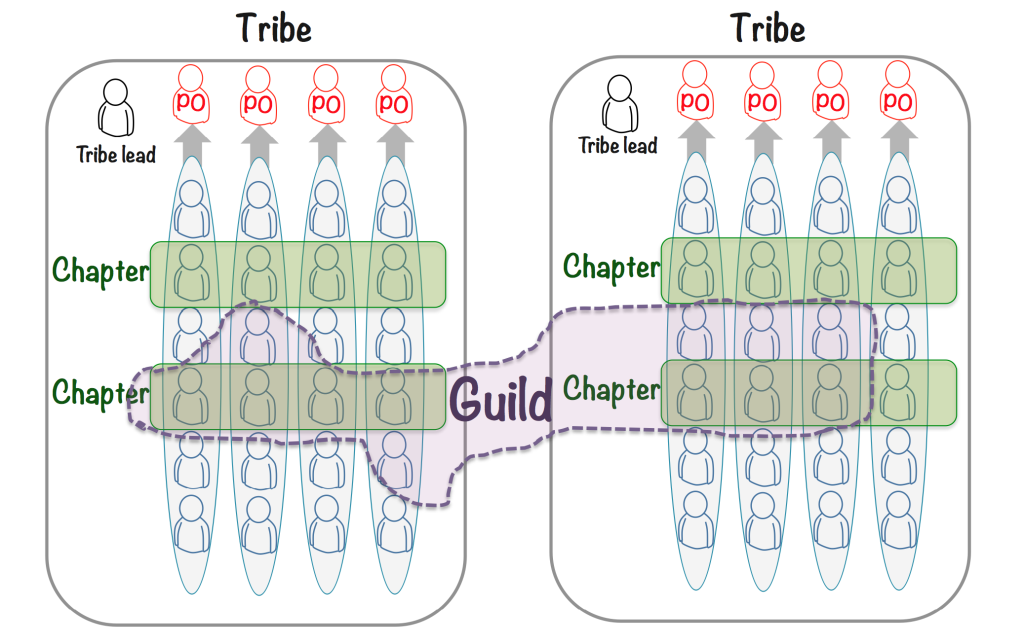
We call these reporting and functional groupings “chapters.” Again, as an example, reporting to me, the tribe lead, are Chapter Leads. In my tribe, there are currently three backend (services) development chapters, two front-end development chapters (including all the UI developers), a core library chapter, and a test chapter. These seven Chapters span eight different squads. Almost every chapter lead has reports in 2 squads, and a few of them have reports in three squads. Almost all chapter leads work within a squad in some capacity as well, either as developer or technical lead, and not necessarily within a squad that has members of their chapter.
This chapters/squads matrix organization is critical to our organizational agility. It allows the squads and the tribe to be more fluid. We can spin up a new squad to take advantage of an opportunity or handle an issue without worry about changing reporting structures. If a squad completes its goals and has no reason to exist anymore, we can dissolve it without punishing a manager. This is a very important difference to a traditional hierarchy, because it gives us a lot of flexibility and helps us avoid the old political issues around empire building and resource contention.
In addition to our Tribes, Squads and Chapters, we also have virtual organizations called Guilds. Guilds are cross-tribe organizations centered on different technical or interest areas and their membership is voluntary. The guilds serve as ways to promote cross-tribe collaboration and communication, especially around things like best practices. For example, we have guilds for Web Development, Agile Practices, Leadership, Test Automation, etc. The guilds foster developer-to-developer communication, which is one of the ways that we keep all these autonomous teams from all going off in completely different directions.
From Henrik’s paper, this diagram illustrates the organizational structure I discuss above:
I’d like to give some more background around why we have implemented this organizational model at Spotify; elaborate on our goals for implementing it, and discuss the aspects of our culture, which have been critical to its success. It is really great that other companies have been inspired by the way we work, but I think if you implement only parts of the model or try to impose it on a very different corporate culture; you will have a difficult time achieving the same level of success with it that we have had.
If you are considering using the Spotify organizational model within your company, there are a few things that will be critical to your success:
Our organization model assumes that engineering is doing development with agile methodologies. Our goals for autonomy mean that we do not prescribe any particular development framework our squads must subscribe to. However, all of squads use agile development methodologies. While we do our best to minimize dependencies between squads and tribes, there will always be some since we are all working on the same product. Any individual squad choosing to build using a traditional waterfall or other non-agile process would not be able to keep up with the rapidly changing teams around them. If they tried to impose some sort of process on other teams so that they could follow a longer-term development plan, they would start slowing down the rest of the organization.
A critical requirement in making our organization model work well is that the entire company works with and understands agile practices and processes. While our legal team isn’t doing scrum or kanban, they are used to working with engineering teams that use agile processes. Having the entire corporation understand and agree with agile means that no line of business area becomes an impediment to the speed of implementation. Think of this in terms of Amdahl’s law, applied to a development organization. If your development teams are working quickly in parallel, but marketing or legal is not supportive of an agile approach, they will become a bottleneck that will slow down the overall speed of the company.
Similarly, implementing this with just one team as a test in a larger engineering organization will be prone to issues. A traditional engineering organization is not usually set up for autonomy. Adding a single autonomous team within that web of dependencies is likely to hamper and frustrate the team and skew the results of the experiment.
While I’ve mentioned autonomy in several places already, I cannot understate its criticality. Each squad must be empowered to make their own decisions, not only on features, but also on development model, infrastructure, and implementation. Every decision that has to be approved outside the team means a delay that slows development. Each dictated implementation or infrastructure decision means that a technology that doesn’t fit to the way the team works or something new that must be learned before the team can build. This is a challenge to coordination, but in practice it isn’t as bad as it might seem. Best practices and technologies do spread from team to team through avenues like guilds. Teams adopt these practices and technologies on their own schedule or pioneer new ways of working if it makes it easier for them to deliver value to our customers and then spread their learnings to the other teams.
Trying to layer the tribe and squads model over a traditional reporting hierarchy would be very problematic. While we have many long-lived squads at Spotify, we are constantly creating and disbanding squads as new needs arise or missions are fulfilled. Squad membership will also ebb and flow as required by the needs of a squad’s mission. Traditional hierarchical organizations are self-perpetuating and restructuring them is very disruptive both to the management chains as well as the individual team members. You would gain some of the benefits of the Spotify model by building full-stack teams in a traditional organizational hierarchy, but you would lose a lot of the overall speed benefits that we leverage with our matrix organization.
In conclusion, if you are looking to improve the speed of your development and are inspired by Spotify’s organizational model, there are a few things that you need to understand. Our model works because it is layered on top of our corporate culture. Our culture values autonomy, agile processes, democratic teams, and servant leadership, amongst other things. You can certainly take some of the ideas from the way we work and apply them in your organization, but without the cultural underpinnings you may not get the same returns.
Some other references worth checking out are Henrik Kniberg’s keynote at the Paris Scrum Gathering and my keynote at the { develop: BBC } conference.
The Known Unknowns
…there are known knowns; there are things we know that we know. There are known unknowns; that is to say, there are things that we now know we don’t know. But there are also unknown unknowns – there are things we do not know we don’t know. – Donald Rumsfeld
Last week I held a day of training for the managers and folks interested in becoming managers in my organization. I did this with a couple of the folks from Spotify’s awesome People Operations team, Paolo and Mats.
As part of the exercises we identified which management skills, values and responsibilities were the most critical for our organization. We then did something like a spider map to help us evaluate our own competencies in these areas, but also to set goals on how we’d like to improve over the next few months. The exercises themselves were awesome, and they identified some truly great qualities of managers and leaders that I hadn’t thought about. I’ll try and write about them in the future.
One thing that struck me as I did this self-assessment was how low I was rating myself on some areas. Areas that my managers had told me that I was strong in. I rated myself low in areas that I would even call my own strengths. The reason was that I had come to realize how much better I could be than I am right now. I knew how much more I had to learn, my known unknowns.
I had noticed this before, in other areas. For years, when I interviewed C++ developers, one of my favorite questions was “how do you rate your C++ skill on a scale from 1 to 10?” Sometimes, I’d add the context of “1 is your dog, and 10 is Bjarne Stroustroup.” What I was looking for was not an assessment of what they knew, but an understanding of what they didn’t know: the known unknowns. I wrote C++ code professionally every day for over 15 years and I would have rated myself a 7 (and that was before C++11 came out). Anyone who rated himself or herself higher than that either was just not being honest (it was an interview situation after all) or they knew so little of the language that they didn’t have a clue how inexperienced they were.
I now realize that this just part of mastery. You reach a plateau in your growth and it seems like you are getting pretty good, but then you grow a bit more and you realize that there is so much more to learn. Ad infinitum.
BBC Academy Video on Engineering Culture
This video only works with UK IP Addresses. Sorry about that…
This includes some short clips from my talk at the BBC in November and has several engineering leaders from the BBC talking about their culture. A good, quick intro.
This page has some more information about the speakers: BBC Academy – Engineering Culture
Some Upcoming Talks in Europe
Happy new year! I’ve got some talks coming up this winter and spring that you may be interested in. In both of them I’ll be talking more about building strong engineering teams and how we build with Agile and Lean at Spotify.
Software 2014
Oslo, Norway - February 26-27, 2014
This is the yearly conference of the Norwegian Computer Society. I’ll be talking as part of the Lean development track. My talk is on Wednesday at 9:45.
Sud Web 2014
Toulouse, France - May 16-17, 2014
The format of this conference looks really great. I’m excited that they asked me to speak. I’ll have more details as the date approaches.
If you are attending either of the conferences above, let me know in the comments or over twitter. Really looking forward to meeting up with people.
My Slides From My BBC Develop Keynote
I had a great time at the BBC Develop conference in London this week. The BBC were gracious hosts, the audience had some good (and not too easy questions) and the program had some really good talks; so I learned quite a bit and met some excellent folks. Special thanks to Tanya Rai, Colin Savage, and Simon Stevenson at the BBC for inviting me and putting on a great day.
tweet: A great post. Management: a rant | By Matt Zimmerm…
A great post. Management: a rant | By Matt Zimmerman via @kstewart mdzlog.alcor.net/2013/11/07/man…
What do I look for when hiring an engineer?
I’m don’t spend much time on Quora, but I was reading a different thread and I came across the question: What Makes a Software Engineer Good? Now anyone who has worked with me can tell you that I am pretty opinionated about this subject. So since there wasn’t already someone saying what I would have, I decided to post an answer. Here is that answer:
I’ve interviewed literally hundreds of software engineers over the last couple decades for my teams at Microsoft, Adobe, Spotify and other places.
Over the years, I’ve honed in on a few things that I consider vital for anyone joining my organization. These are the kinds of things that I value as a hiring manager, of course. Others will have their own critical criteria.
These are in a rough priority order.
1) Pragmatism
I don’t bother with tricky or difficult programming questions designed to test a corner of your knowledge or some trivia. Instead I ask a dead simple question. Something anyone could do. Then I complicate it. And complicate it again. And again. I look for the point where you can no longer adapt your very first answer. What I want to know is that you are willing to throw away your first answer when it no longer makes sense. You’d be amazed how many engineers will hack on something that will never work when they could throw it away and do something much simpler in a quarter of the time.2) Interest
Do you actually like writing code every day? Do you read programming blogs for fun? Do you work on your own coding projects outside of work? If this is going to be your job, I want someone who is overjoyed that they get paid to write software. Not someone who’d rather be doing something else.3) Attitude / humility
I’ve worked with brilliant people who are jerks. For every inch they moved the product forward with their innovation or genius, they moved the project back two inches by being impossible to work with. I want someone who is there to make the team better, not someone who feels like everyone just “needs to do as they are told.”4) Intelligence
Yeah, you do need to be smart. Writing software is part art and requires creativity, but it is also a lot about problem solving and just sheer brainpower to figure out why this thing is crashing, but only on Tuesday when the moon is full.5) Programming languages / domain experience
I have worked professionally with a dozen or more programming languages. Some I don’t even remember anymore. While I have a lot of depth in some of them through years of experience, I have been able to learn others as I need to in order to suit the project. I would prefer to see someone with some proficiency in more than one language because that shows some breadth and a willingness to learn, but as long as you can code and are smart (see #4) you can probably pick up whatever language we are working in reasonably fast. I hire for the long term, we can take a bit longer to get you up to speed if you’re a good fit. Similarly with domain experience. If you have an aptitude, we can teach you.I do have a couple caveats to #5 though:
If I’m hiring for a senior position that requires domain knowledge, yeah, that is in the job requirements, so you need to bring that. You would still need to handle 1-4 though.On languages, there is a major caveat. If we’re doing C++ or C, you’ll need to have some experience there. If you’ve only ever worked with high-level, garbage-collected languages, it will simply take too long to really bring you up to speed. I’ve tried this too many times in the past and have realized that it usually isn’t worth the effort.
tweet: KISSmetrics has a “happiness manager”, great idea…
KISSmetrics has a “happiness manager”, great idea for a small (or large) company #cultivatecon
Why I love physical agile boards, part two
I thought of this as I was writing the previous post, but decided that it was important enough that it deserved it’s own discussion.
Another benefit of physical agile boards is that, by their nature, they tend to limit the scope of your planning. To some, this may sound like a bad thing. It is actually one of the most difficult disciplines to maintain in agile development.
One of the things that distinguishes agile development from older development models is that Agile keeps the time horizons close. This is beneficial because the nature of software and systems development is ever changing, and long-term plans are almost always upset by the realities of the industry and of development itself.
Even strong agile teams see opportunities and features that don’t make sense right now, but they know they will want “someday,” The tempting thing in Scrum is to add these into the backlog, so that they aren’t forgotten. In Kanban, they may go into the “not started” column or some other “feature stash” (The Product Owner and I had a secret Trello board called this when I worked on Revel at Adobe). These far-off stories and epics become their own drag on the agile process, slowing down backlog grooming and sprint planning as the backlog becomes less and less manageable and stories get re-added because no one can find anything.
A physical board actually makes it physically difficult to do this kind of faux-waterfall long-term planning. There just isn’t anywhere to put the post-its/cards! The Product Owner may still have their personal feature stash somewhere, but it won’t become a drag on the whole team.
Similarly, the lack of physical space makes it difficult to over-plan the stories that are in front of the team too. When I was doing Scrum as front-line engineering manager, I found it difficult to figure out how many stories we should break down for a sprint in order to not run short. The tendency was always to task out a lot more stories than we needed, just-in-case. The virtual board makes it easy to plan as many stories as you want. In practice, stories have dependencies on each other and if you over-plan, you tend to just write incorrect tasks.
A physical board encourages you to plan just as much as you need, and not much more.